
Saturday, October 17, 2015
Saturday night fun!
I hope all my students are having a fantastic time at the Cove Carnival tonight.... While I am spending Saturday night grading narrative essays! Oh, the glamorous life of an English teacher!!

Wednesday, October 14, 2015
Thursday, October 8, 2015
Narrative Essay Rubric
View the rubric indicators below, or click on the link to download a copy.
Printable Rubric
Criterion
for Evaluating Essay:
|
Student
|
Teacher
|
Overall
I presented and told a personal
story that had well developed characters, tension, and a clear theme that
shares a life lesson with the audience. My writing is organized and proves
mastery of concepts taught throughout the unit.
|
____
|
____
|
Format
My essay is typed,
double spaced, size 12 Times New Roman font or neatly handwritten in ink,
with a heading and inviting/unique title that references the theme of my
story. I wrote introduction and conclusion paragraphs that explain how my
personal story connects to the lesson/message.
|
____
|
____
|
Lead
I wrote a beginning in which I not only set
the plot or story in motion, but also introduced the larger meaning (lesson)
the story would convey. I explained the significance of the lesson and its
value to society.
|
____
|
____
|
Transitions
My transitions
helped the reader follow my lines of thinking. Transitional language is used to move the
reader from one paragraph to the next. I used transitional phrases to connect what happened to why it
happened.
If…, I hadn’t…, I might not have…, because
of…, although…, and little did I
know that…
|
____
|
____
|
Ending
I wrote an ending that connected to what the
story was really about.
My conclusion paragraph gave readers a sense
of closure by showing a new realization, insight, or a change that I
experienced as a result of what happened in my story. I emphasized the value
of the lesson I learned, and how others could learn from it as well.
|
____
|
____
|
Organization
My paper included an introduction, the
personal story, and a conclusion. In the story, I used paragraphs
purposefully to show time or setting changes; new parts of the story; or to
create suspense for readers. I described
a sequence of events that was clearly connected to the overall message/lesson
I was conveying.
|
____
|
____
|
Elaboration
I developed realistic characters and
developed the details, action, dialogue, and internal thinking that
contributed to the deeper meaning of the story.
|
____
|
____
|
Description
I developed character traits and emotions
through what I said and did. In my
story, I chose several key parts to stretch out and several to move through
more quickly. I used precise descriptions, figurative language, and symbolism
to help readers picture the setting, actions, and events, and to bring forth
meaning.
|
____
|
____
|
Grammar/Punctuation
I used punctuation to clarify and
emphasize quotations and to enhance meaning.
(I used punctuation such as dashes,
colons, parentheses, and semicolons to help me include or connect extra
information in some of my sentences.)
|
____
|
____
|
Spelling
I spelled technical terms and
literary vocabulary accurately.
|
____
|
____
|
Grade
|
____
|
____
|
Sample essay
Use the sample essay below as an example of how to put your own writing together for publication. Notice how the writer transitions between the different parts of the assignment (introduction, personal story, conclusion) and how the message to the audience is clearly referenced from beginning to end.


Endings
How to set up a conclusion for your "Narrative Essay"
Checklist
1. Closure! - Give the audience some closure to your story.2. Reflect- explain how you have changed as a result of this experience in a way that your audience can relate.

Formatting Reminders
 |
Use the reminders above when typing your "Narrative Essays,"
due at the end of this week.
|
Don't forget:
Filename for the document is LastName Narrative Essay
Name, date, assignment goes in the top left of the paper
Double Space
Type in size 12 Times New Roman
Spellcheck!!
Write a unique/original title
Warning
Join us to celebrate our freedom to read by taking part in "Banned Book Week!" Stop by the library and check out their amazing display of books that have been under scrutiny over the years. Some of the titles will shock and amaze you!
| It's Banned Book Week!! How many illegal books have you read?!? |
From Ms. Poulos in the Media Center:
Celebrate the Right to Read!
What do Harry Potter, Captain Underpants, and To Kill a Mockingbird have in common? All have been books that in some places, people have challenged or tried to ban from libraries.
"Banned Books Week is the national book community's annual celebration of the freedom to read. Hundreds of libraries and bookstores around the country draw attention to the problem of censorship by mounting displays of challenged books and hosting a variety of events. The 2015 celebration will be held September 27-October 3.
Banned Books Week was launched in 1982 in response to a sudden surge in the number of challenges to books in schools, bookstores and libraries. More than 11,300 books have been challenged since 1982 according to the American Library Association. There were 311 challenges reported to the Office of Intellectual Freedom in 2014, and many more go unreported."
Visit the SDMS Library Media Center and check out a book on its display of frequently challenged books!
For more information, go to:
Your attention please..... Easy Introductions
How to set up an introduction for your "Narrative Essay"
Checklist
1. Hook the audience! - write lead sentence that peaks the audience's interest and convinces them to keep reading. (Hint- my story is about.... is not going to cut the mustard!)2. Preview the story- briefly give the audience any background info they need to understand your story without giving anything away.
3. Hint at the lesson- give the audience a quick taste of the nature of your lesson
4.Thesis Statement- state the valuable lesson you learned from your experience in the narrative story.
 |
The sample above shows an introductory paragraph that familiarizes the audience with the author's life, setting up for the narrative story to come, and also tells the audience the purpose behind the story (the "lesson"). The area identified by the green markers both hints at the lesson and states it directly at the end (items 3 & 4 on the intro checklist- above). |
Sunday, October 4, 2015
YA new releases
So..... It's after midnight and Angela is up sick. While she eats Popsicles and watches "Pirate Fairy," I am looking up newly released young adult titles for my Indigo Team library.
http://www.goodreads.com/genres/young-adult


Thursday, October 1, 2015
What is a "Narrative Essay?"
Think of this paper as a modified argument essay.
First, you will tell your audience about an important life lesson you want them to learn. Then, you will tell them a personal story that explains about a time in your life when you learned that lesson (hint-maybe you learned it the hard way, and you are trying to prevent them from making the same mistakes that you did??) This is the proof/evidence that makes the audience listen to you and agree that- yes that is an important life lesson.
Your paper will be divided into three sections:
1. Introduction (1- paragraph)
a) Set up the background for your story. Introduce yourself, and explain any info needed for the audience to understand the story (location/time-frame/important situations happening in your life)
b) Hint at the lesson you are going to share. (This should be the last few sentences of the introductory paragraph)
2. Personal Story (multiple paragraphs)
a) Write a detailed narrative (story) that explains a time in your life when you learned an important lesson that applies to everyone. This story is the proof/evidence that proves to the audience that the lesson you are sharing is valuable.
3. Conclusion (1-paragraph)
a) Remind the audience of the lesson you are teaching them (first few sentences)
b) Sum up the story and reflect on how the experience changed you
c) Explain why this is an important lesson for everyone to learn (last sentence)
REMINDERS...
-Write in the first person P.O.V (I, me, my, we, our)
-The story section of the paper is kind of like a flashback
-Think of a creative title for your paper that is related to the lesson
-Type in size 12 Times New Roman font
-Spelling/grammar/punctuation rules apply "Narrative Essay
First, you will tell your audience about an important life lesson you want them to learn. Then, you will tell them a personal story that explains about a time in your life when you learned that lesson (hint-maybe you learned it the hard way, and you are trying to prevent them from making the same mistakes that you did??) This is the proof/evidence that makes the audience listen to you and agree that- yes that is an important life lesson.
Your paper will be divided into three sections:
1. Introduction (1- paragraph)
a) Set up the background for your story. Introduce yourself, and explain any info needed for the audience to understand the story (location/time-frame/important situations happening in your life)
b) Hint at the lesson you are going to share. (This should be the last few sentences of the introductory paragraph)
2. Personal Story (multiple paragraphs)
a) Write a detailed narrative (story) that explains a time in your life when you learned an important lesson that applies to everyone. This story is the proof/evidence that proves to the audience that the lesson you are sharing is valuable.
3. Conclusion (1-paragraph)
a) Remind the audience of the lesson you are teaching them (first few sentences)
b) Sum up the story and reflect on how the experience changed you
c) Explain why this is an important lesson for everyone to learn (last sentence)
REMINDERS...
-Write in the first person P.O.V (I, me, my, we, our)
-The story section of the paper is kind of like a flashback
-Think of a creative title for your paper that is related to the lesson
-Type in size 12 Times New Roman font
-Spelling/grammar/punctuation rules apply "Narrative Essay
Wednesday, September 30, 2015
What's the Big Idea?!?
Since the early civilizations, people have taught lessons by sharing stories. We need to dig down to the root of stories about our own lives; figure out how to take what we learned from that experience; and package it with the intent of passing on our new-found wisdom to others.

I have what I consider to be a "healthy fear" of spiders and other insects. However, when I encounter creepy crawlies with my kids, I make sure that I put on a brave face to prevent them from inheriting my irrational feelings about bugs. I will calmly pick up a grasshopper and set it free in nearby shrubbery while my kids are watching, even though I am cringing on the inside. If I were to write a story about having to be brave in front of my kids I might focus around the theme that "sometimes being brave for others forces us to find some inner strength." I would use a detailed narrative about a specific moment in my life that demonstrates the lesson I was trying to convey. The story would be my "proof" or "evidence" that supports the validity of my claim that sometimes it is necessary to put on a brave face for others.


Tuesday, September 29, 2015
Punctuating Dialogue
Rules for writing dialogue:
1. Put speech marks around the words being spoken.
2. Punctuate the speech before closing speech marks.
3. Start a new line for each new speaker.
4. Capitalize the first word in spoken phrase.

“Gosh I hope that was no one I knew,” Calvin mumbled through his scarf. Mom offered Calvin some treats to warm him up.
“You looked pretty cold coming up the hill, so I fixed you some hot chocolate and crackers with peanut butter,” she explained. “Go wrap up in a blanket and take these in front of the fire. Here’s Hobbes and a comic book. Getting Toasty?” she asked.
“Uh huh. Thanks,” he replied.
“You looked pretty cold coming up the hill, so I fixed you some hot chocolate and crackers with peanut butter,” she explained. “Go wrap up in a blanket and take these in front of the fire. Here’s Hobbes and a comic book. Getting Toasty?” she asked.
“Uh huh. Thanks,” he replied.
Thursday, September 24, 2015
Break it down!

Breaking down our writable moments to dig for details... Try to think of each memory as a progression of: emotions, actions, thoughts (reflection), dialogue. Charting these details on simultaneous timelines can help turn a simple description into an opportunity for a meaningful memoir.


Some student samples....


Tuesday, September 22, 2015
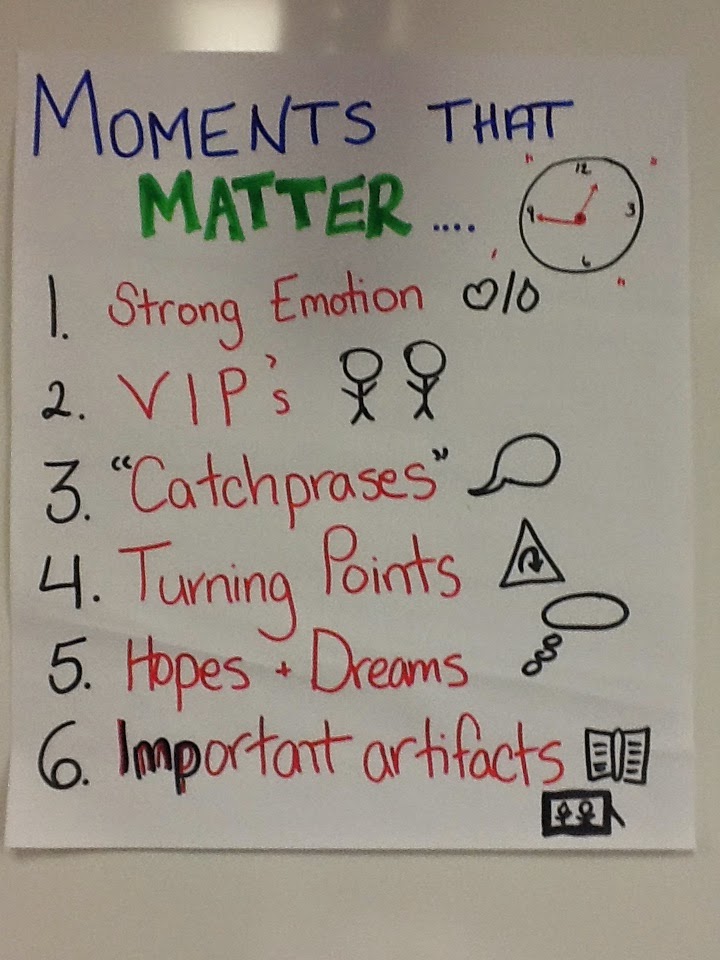
Moments that Matter
Use the following techniques to make a list of 15 moments that are worth writing about from your own lives.
Friday, September 18, 2015
Congrats.... you've been published!
Revising a rough draft from your Writers' Notebook and getting it ready for publication is easy to do, if you stay organized.
Create a Plan for Publication.

Create a Plan for Publication.
- Choose an entry that you are proud of (that you think you can easily beef up and revise)
- Reread the entry and make a list of "anything that's missing" and make revisions
- Write an introduction and a conclusion
- Check spelling/grammar/punctuation
- Type or handwrite neatly in blue or black ink
Congratulations!

Thursday, September 10, 2015

Wednesday, September 9, 2015


Wednesday, September 2, 2015


You are what you Read!
What we read shapes who we are as people. Some books teach us lessons about life; others help us deal with tough situations that we might be experiencing, and some books are special because they hold memories of loved ones. The books that significantly impact us become part of our identity, a literary fingerprint.
 |
| Look closely to see the book titles in the ridge details of this "fingerprint" |
Subscribe to:
Posts (Atom)